Why You Should Care About Climate Change

My freshman year of college I took an advanced writing course. One of our assignments was to write a ten page persuasive paper about a topic we cared a lot about. Naturally, I chose climate change. I found the final draft of this paper a few days ago and wanted to share it with y'all. As you read, keep in mind it is a few years old now so some facts/statements are outdated. Nevertheless, there is still valueable and relevant information throughout it. I hope you enjoy!
I love animals. In fact I love them so much that I decided to dedicate my life to saving them from extinction. Currently I’m studying to be a wildlife biologist and I love learning about different ways we can preserve biodiversity. But all of the different methods really don’t matter if we do not address the most existential threat to all life on earth: climate change. Climate change affects almost 11,000 different species of which several have already gone extinct because of it (WWF). Soon, its effects will be seen and felt by every single human on earth. There is a lot of debate over how aggressive we should be treating it, who’s fault it is, where the money to mitigate it would come from, and how it would affect economies throughout the world. These are all complex problems that need answers, but before we can do anything about it, every citizen of every country must believe and acknowledge climate science, so we can push for change and give our political leaders no choice but to act, and act now. Climate change has been so politicized here in the US, but its effects are nonpartisan. It doesn’t care if you are liberal or conservative, democrat or republican. Disputing the reality and credibility of the science only further delays long overdue systemic change on an issue that has already cost billions of dollars and thousands of lives. Science should never be partisan and action on life threatening issues such as climate change should not be delayed because of its denial.
Scientists have rarely come to a consensus about any subject, yet 99% of climate scientists agree that climate change is happening and that it is human caused (Lynas). In fact, climate scientists are more certain that climate change is human caused than the medical profession is certain that smoking causes lung cancer(NBC 10). I understand that a lot of people have done their own research on this topic, and that’s great! But, people should not form their opinions based on what 1% of scientists believe. Instead, they should be based on the consensus of the entire scientific community. The arguments we usually hear about this topic are not about whether it exists, but whether or not we should accept the science and if we should take action. A study led by J. Stuart Carlton, the assistant director of the Illinois- Indiana Sea Grant, found that scientists who cast doubt on climate science are almost always scientists from other disciplines who “disagree over basic facts” (Carlton). Although it's amazing that scientists from different disciplines are trying to learn and study about climate change, we can’t afford these kinds of mistakes on such a life changing issue. Going to non-climate scientists for climate facts is like going to a podiatrist for a cardiovascular condition. It just doesn’t make sense.
If we are so sure about climate science, why are there still so many climate skeptics? Research has shown that most skepticism comes from “those who hold more egalitarian and communitarian values [because they] tend to perceive environmental risks more acutely because they feel that commerce and industry (the drivers of many environmental risks) promote individuals over the community”(Carlton). It has also been proven that “cultural cognition appears to influence climate change beliefs among everyone, not just those who are uninformed about climate change or who have insufficient reasoning skills to properly evaluate the evidence for anthropogenic climate change”(Carlton). In other words, those who don’t believe in climate change tend to be more focused on themselves as individuals and the benefits they can personally gain instead of seeing the broader community. Whether a person has individualistic or communitarian values is a significant indicator on whether or not they believe in human caused climate change. This is where the political divide between climate believers and deniers comes in as well. Although the success of individuals within a society is vital, climate change is something that needs to be addressed for both egalitarian and communitarian reasons. Individuals and communities around the world will feel the ravages of climate destruction either physically or economically. Research also shows that one reason climate change is divided among political parties is because “mentions of scientists are decreasing in climate coverage, which may indicate that scientific discourse is being replaced by political discourse”(Chinn). Another stems from the success of Tea Party candidates in the 2010 election, which placed belief in climate change with partisan identity. This is why poll results show that 70% of liberal Democrats “trust climate scientists a lot to give full and accurate information about the causes of climate change, compared to just 15% of conservative Republicans”(Pew).
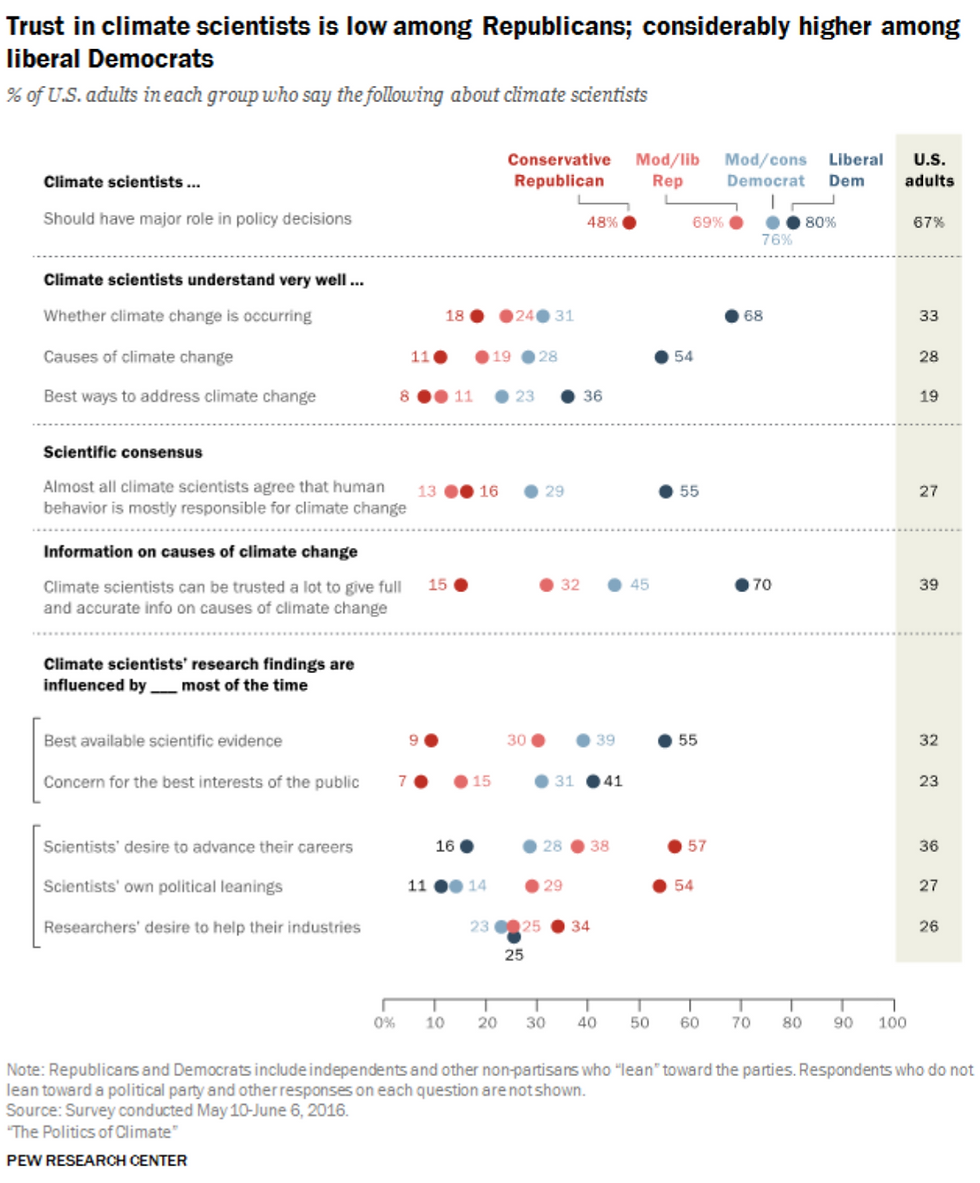
Politics should not be divided over whether or not we accept science. Instead, the real debate should be over the different ways to solve the many climate problems that our nation faces.
I love that everyone has their own lens of the world and I believe that our world is better because of that diversity. But I also believe that action against a serious threat to humanity such as climate change cannot afford to be delayed. So if you are someone who does not believe in anthropogenic (human caused) climate change, I appreciate your views and opinions, but I want to spend a few minutes and present to you the science and common counter arguments for the purpose of encouraging more unification on this issue.
One common argument people use to deny climate change is that the earth goes through natural cycles of warming and cooling. This is true! Climate scientists know this and have been carefully tracking the earth’s gradual warming since before the industrial revolution, which was the turning point. Before 1950, which was when we started to see a change in temperature from the gradual accumulation of massive amounts of greenhouse gasses emitted from the industrial revolution to then, carbon dioxide levels had not been over 300 parts per million for hundreds of thousands of years (NASA). This is because of the invention of engines, factories, and mass agriculture. This increase in carbon dioxide directly correlates to an increase in temperature. In 1950, NASA found the temperature anomaly, which is the difference from the average or baseline temperature, to be .12 degrees Celsius. This increases with a linear slope and NASA found the temperature anomaly for 2020 to be 1.2 degrees celsius(NASA). So yes, temperatures have been changing for all of earth’s history, but the rate at which this temperature change occurs is vital. The fact that the rate of warming was steady until the industrial revolution, when large scale fossil fuel burning began, is evidence that humans are causing it. Because global warming is happening so quickly, species and habitats cannot evolve fast enough to be able to survive and be successful in this new climate. This is causing a mass extinction event and a biodiversity crisis in many of earth’s biomes.
But how does carbon dioxide relate to temperature rise? Carbon dioxide is a greenhouse gas which means that it acts like a blanket over the earth that traps the sun’s heat.


The thicker the blanket, the more heat it traps. Above are graphs that show how carbon dioxide emissions have changed since large scale fossil fuel burning and how it correlates with temperature anomaly. As we can see from the graphs, carbon dioxide emissions are directly related to increased temperature anomaly.
We often hear goals that try to keep us under two degrees of warming but two degrees does not sound like a big deal right? Well, that’s not exactly the case. At 2 degrees celsius, there would be more droughts and heatwaves which would result in agricultural failure, leading to food insecurity. It would also displace numerous people, primarily in poorer countries. With two degrees of warming, 18% of insects, 18% of plants, and 8% of vertebrates would lose their habitats and thousands of species would face extinction, which will severely cripple the global biosphere (WWF). In addition, our oceans would suffer due to sea levels rising several feet, causing flood destruction for coastal communities, as well as stronger hurricanes. Our oceans are being heavily affected by climate change. As greenhouse gasses accumulate and trap heat, the ocean increases in temperature and sea levels rise. This results in marine life being altered because different species will reallocate, changing migration patterns, changing nutrient cycling, growth of harmful algae blooms, and it would also “threaten sensitive ocean life such as corals”(EPA). The ocean and atmosphere are interconnected. Ocean warming has “led to an increase in the amount of atmospheric water vapor in the oceans”, leading to increased precipitation in some areas but droughts in other areas due to the ocean shifting storm tracks (EPA). Also, carbon dioxide is 30 times more soluble in water than in air, causing it to dissolve in the ocean producing carbonic acid, which lowers its pH. This increase in acidity harms marine life by bleaching coral reefs, making it more difficult for organisms to produce “calcium carbonate, which is the main ingredient in their hard skeletons or shells (EPA).
It turns out that loss of biodiversity on the planet negatively affects humans. Humans and nature are intertwined and we depend on the earth. If biodiversity is lost, we will see increased food insecurity due to the loss of pollinators such as bees, crop failure due to the loss of microorganisms and invertebrates in soil, and loss of ecosystems that provide humans with clean air, water, and medicines (Fernandes). Human economic success is also tied to the health of the planet. There have been studies that conclude that the value of biodiverse ecosystems is about $24 trillion and land degradation has caused the global economy to drop by about 10%. The IUCN has also valued the amount of goods and services that the planet provides at $33 trillion a year. Our earth provides us with services such as natural pollination, pollution regulation, and natural disaster regulation. We often take it for granted and forget how much value that has.
Now, you may think that climate change does not affect humans directly, but science has concluded that it does have a detrimental effect on human health. The Centers for Disease Control and Prevention says that climate disruptions “include increased respiratory and cardiovascular disease, injuries and premature deaths related to extreme weather events, changes in the prevalence and geographical distribution of food- and water-borne illnesses and other infectious diseases, and threats to mental health”(CDC). In fact, thousands of people have already died because of the effects of climate change, primarily in poorer countries.
The World Health Organization says some of the exact climate related causes for these deaths are: extreme weather conditions, changes in rainfall that result in water borne illness, and malnutrition from changing patterns of food production(WHO). This is not being talked about nearly enough in climate related media. The fact that people are already dying due to a warmer climate is cause for great concern seeing as we haven't even experienced the worst of it. We need climate action and we need it now.

So how can we mitigate climate change and prevent two degrees of warming? We need to vote for people who will introduce climate policy. But the kind of climate policy that will truly make a difference will be difficult to pass because “major federal legislation will require not only a supportive president, but also sixty votes in the Senate to overcome a filibuster, or 51 votes to replace the filibuster rule, and five votes on the Supreme Court to overcome legal challenges”(Gillis). For that to happen we need bipartisan action. Given today’s political climate, it has not seemed like this would be a possible feat, but recently we’ve seen that such cooperation is possible with three Republican members of congress attending the COP26 climate conference in Glasgow. Despite historic denial of climate science, Republican congressman John Curtis said that “Republicans care deeply about the environment and preserving it for future generations”(The Guardian). These GOP congressmen said that their constituents are concerned about climate change so they want to be at the table when climate policy is being written. This is amazing. We are seeing a slow crack into what can blossom into wonderful and productive bipartisanship. We need this to fully develop and become the norm if we want to see any change and development for any issue in our country- not just climate change.
The fossil fuel industry is one of the biggest emitters of greenhouse gasses in the world and is very unsustainable for the planet. We need to replace nonrenewable sources of energy with renewable versions and leave fossil fuels in the earth, by building infrastructure for renewable energy. According to BP’s Statistical Review of World Energy in 2016, we only have “about 115 years of coal production, and roughly 50 years of both oil and natural gas remaining”(Ritchie). Our society is built on fossil fuels and if we do not start including more renewable energy production and increase our reliance on it, by the time fossil fuels run out, the world would be in a self-inflicted panic. The generations that come after us should not have to suffer because of our close mindedness and denial of science. This leaves us with the responsibility and duty to stop contributing to the problem and start finding and implementing solutions so we can have a livable future. We can start making a difference right now with the technology we already have and help accomplish such a daunting task.
Setting up public transportation and walkable streets would drastically reduce carbon emissions as the transportation sector is the second highest source of greenhouse gas emissions in the United States. A single gallon of unleaded gas produces 20 pounds of carbon dioxide(WWF). Big cities need more rentable electric bikes and scooters, longer bus routes, and more pedestrian friendly walking routes. If we pair public transportation with renewable energy, we would see a giant reduction in emissions.
Some other solutions include making roofs of buildings into green buildings to reduce energy usage, reducing rainwater in sewage systems to spend less energy managing water, restoring wetlands, to buffer shorelines and to protect coastal areas, growing the solar and wind energy sector, and so much more (Environmental Protection Agency). We already have plenty of solutions, we simply need to implement them in a way that is safe for both the economy and the planet.
While we already have some ways to prevent two degrees of warming, even if we implemented them and every individual tried to be the most eco-friendly version of themself, the climate crisis would not be completely solved. 100 companies are responsible for 71% of emissions(The Guardian). The Carbon Majors Report found that Exxon, Shell, BP, and Chevron are among the “the highest emitting investor owned companies since 1988”(The Guardian). The report also found that “if fossil fuels continue to be extracted at the same rate over the next 28 years as they were between 1988 and 2017... global average temperatures would be on course to rise by 4C by the end of the century”(The Guardian). This would be catastrophic to all ecosystems and communities on the planet.
Where we put our money is also extremely important, not just with the companies we support, but also in our future investments. “A fifth of global industrial greenhouse gas emissions are backed by public investment” according to the CM Report. We are starting to see that investing in renewable energy will make investors more money in the long run as the industry grows. The planet and its people benefit from less emissions and investors will win by seeing more profit. As consumers, we have a lot of power. Every time we buy something, we are telling that company that you support everything about it. How it was made, where it was made, who made it, where the materials came from, and so much more. This is where the term “vote with your dollar” came from. We as consumers must “vote” for sustainable practices, materials, and impact. This way companies will see demand for sustainability and be more willing to implement these practices that are good for the earth.
No matter what race, religion, political beliefs, background, culture, or gender, we all need to do our part in the fight against climate change. Its effects will be felt by the whole world and bring catastrophic disaster. It is time that we come together and make science bipartisan so we can heal our earth. The idea that I can personally make a difference for the planet whether it be by devoting my future career to it, voting for climate policy, or buying sustainable products, is what sparks a never ending fire in me. I am so passionate about this earth and preserving its beauty and biodiversity for us and future generations. The fact that my grandchildren risk not seeing magnificent animals such as elephants, gorillas, or polar bears is unbelievably tragic. The fact that they will be the ones who suffer more because of the inaction of today’s generation is simply unacceptable. We cannot afford to hold ourselves and our futures hostage by our inaction now.
Works Cited
Asplund, Therese. “Natural versus Anthropogenic Climate Change: Swedish Farmers’ Joint Construction of Climate Perceptions.” Public Understanding of Science, vol. 25, no. 5, 2014, pp. 560–575., doi:10.1177/0963662514559655.
Averchenkova, Alina, et al. “The Influence of Climate Change Advisory Bodies on Political Debates: Evidence from the UK Committee on Climate Change.” Climate Policy, vol. 21, no. 9, 2021, pp. 1218–1233., doi:10.1080/14693062.2021.1878008.
Bayeh, Birhanu, and Melkamu Alemayehu. “Scientific Community Debates on Causes and Consequences of Global Warming: Review.” Journal of Agriculture and Environmental Sciences, journals.bdu.edu.et/index.php/jaes/article/view/201/301.
Biello, David. “10 Solutions for Climate Change.” Scientific American, Scientific American, 26 Nov. 2007, www.scientificamerican.com/article/10-solutions-for-climate-change/.
Carlton, J S, et al. “The Climate Change Consensus Extends beyond Climate Scientists.” Environmental Research Letters, vol. 10, no. 9, 2015, p. 094025., doi:10.1088/1748-9326/10/9/094025.
Carrico, Amanda R., et al. “Does Learning about Climate Change Adaptation Change Support for Mitigation?” Journal of Environmental Psychology, vol. 41, 2015, pp. 19–29., doi:10.1016/j.jenvp.2014.10.009.
“Climate Change Evidence: How Do We Know?” NASA, NASA, 12 Oct. 2021, climate.nasa.gov/evidence/.
“Climate Change.” World Health Organization, World Health Organization, 7 Dec. 2010, www.who.int/heli/risks/climate/climatechange/en/.
“Climate Effects on Health.” Centers for Disease Control and Prevention, Centers for Disease Control and Prevention, 2 Mar. 2021, www.cdc.gov/climateandhealth/effects/default.htm.
Environmental Protection Agency. (n.d.). Green Infrastructure for Climate Resiliency. EPA. Retrieved December 7, 2021, from https://www.epa.gov/green-infrastructure/green-infrastructure-climate-resiliency.
EPA, Environmental Protection Agency, www.epa.gov/climate-indicators/climate-change-indicators-ocean-acidity.
Fernandes, K. (2021, March 1). International Day for biodiversity 2020. The CSR Journal. Retrieved December 9, 2021, from https://thecsrjournal.in/international-day-biodiversity-2020/.
Gillis, Ash, et al. “Convincing Conservatives: Private Sector Action Can Bolster Support for Climate Change Mitigation in the United States.” Energy Research & Social Science, vol. 73, 2021, p. 101947., doi:10.1016/j.erss.2021.101947.
“Global Surface Temperature.” NASA, NASA, 20 Oct. 2021, https://climate.nasa.gov/vital-signs/global-temperature/.
“Just 100 Companies Responsible for 71% of Global Emissions, Study Says.” The Guardian, Guardian News and Media, 10 July 2017, www.theguardian.com/sustainable-business/2017/jul/10/100-fossil-fuel-companies-investors-responsible-71-global-emissions-cdp-study-climate-change.
Lynas, Mark, et al. “Greater than 99% Consensus on Human Caused Climate Change in the Peer-Reviewed Scientific Literature.” Environmental Research Letters, vol. 16, no. 11, 2021, p. 114005., https://doi.org/10.1088/1748-9326/ac2966.
Malhi, Yadvinder, et al. “Climate Change and Ecosystems: Threats, Opportunities and Solutions.” Philosophical Transactions of the Royal Society B: Biological Sciences, vol. 375, no. 1794, 2020, p. 20190104., doi:10.1098/rstb.2019.0104.
Milman, Oliver. “Republicans' COP26 Hopes Undermined by Colleagues' Climate Disdain.” The Guardian, Guardian News and Media, 8 Nov. 2021, www.theguardian.com/us-news/2021/nov/08/republicans-cop26-glasgow-un-summit-climate-talks.
NBC10 Boston. “Here's How Climate Change Has Become Politicized.” NBC Boston, NBC10 Boston, 13 Aug. 2020, https://www.nbcboston.com/multimedia/how-climate-change-has-become-politicized/2177244/.
NewsHour, PBS. “Why 2 Degrees Celsius Is Climate Change's Magic Number.” PBS, Public Broadcasting Service, 3 Dec. 2015, www.pbs.org/newshour/show/why-2-degrees-celsius-is-climate-changes-magic-number.
Nycsea. “Politicization and Polarization in Climate Change News Content.” NYCSEA, nycsea.org/special_issue_view.php?id=6.
“Our Planet Is Warming. Here's What's at Stake If We Don't Act Now.” WWF, World Wildlife Fund, www.worldwildlife.org/stories/our-planet-is-warming-here-s-what-s-at-stake-if-we-don-t-act-now.
“The Politics of Climate Change in the United States.” Pew Research Center Science & Society, Pew Research Center, 21 Aug. 2020, www.pewresearch.org/science/2016/10/04/the-politics-of-climate/.
Reside, April E., et al. “Adapting Systematic Conservation Planning for Climate Change.” Biodiversity and Conservation, vol. 27, no. 1, 2017, pp. 1–29., doi:10.1007/s10531-017-1442-5.
Ritchie, Hannah. “How Long before We Run out of Fossil Fuels?” Our World in Data, ourworldindata.org/how-long-before-we-run-out-of-fossil-fuels.

Comments